

Bed, headstock, tailstock, carriage and feed mechanism of the centre lathe.
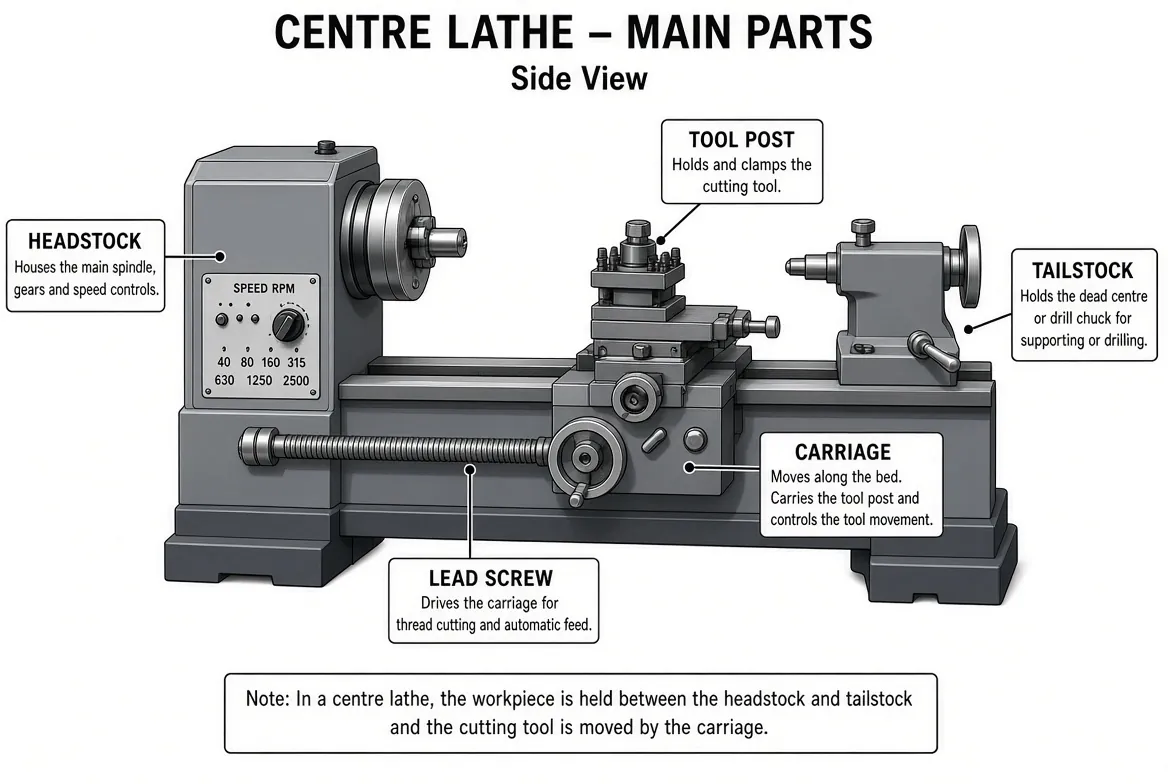
The lathe is a machine tool that removes metal from a rotating job with a single-point cutting tool. It produces cylindrical shapes. The most common type is the centre lathe (engine lathe). Its size is given by the height of centres and the distance between centres.
Main parts
| Part | Function |
|---|---|
| Bed | Rigid cast iron base with accurate guideways (V and flat); carries the headstock, tailstock and carriage. |
| Headstock | Fixed on the left; contains the hollow spindle and speed-changing gears. The chuck or face plate is mounted on the spindle nose. |
| Tailstock | On the right, slides on the bed; supports long jobs with a dead centre, holds drills and reamers in its barrel (quill). |
| Carriage | Moves the tool along and across the job. |
| Feed mechanism | Feed gear box, lead screw (for thread cutting) and feed rod (for turning feed). |
Parts of the carriage
- Saddle – slides on the bed guideways (longitudinal movement).
- Cross-slide – moves the tool at 90° to the axis (cross feed, facing).
- Compound rest (top slide) – can be swivelled to any angle; used for short taper turning.
- Tool post – holds the cutting tool.
- Apron – front part with hand wheel, feed levers and half-nut lever (engages the lead screw for threading).
Quick Revision
- Lathe: rotating job + single-point tool.
- Main parts: bed, headstock, tailstock, carriage, feed mechanism.
- Carriage: saddle, cross-slide, compound rest, tool post, apron.
- Lead screw for threading, feed rod for turning.
Your progress is saved on this device.