

Why surfaces are scraped, types of scrapers, blue matching and bearing marks.
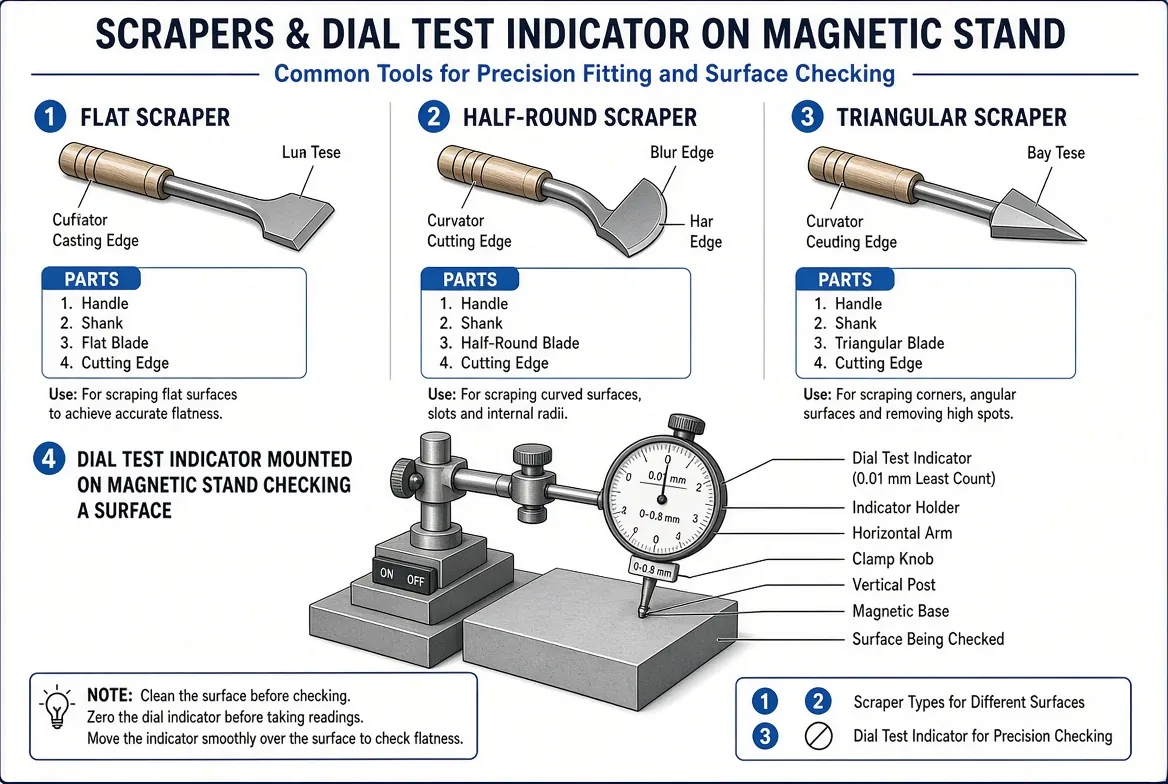
Scraping is removing very small amounts of metal (high spots) by hand with a scraper to get a truly flat or perfectly fitting surface. It is used for machine slideways, surface plates and bearings.
Purpose
- To produce a flat and true surface.
- To get a perfect fit between mating parts (bearing and shaft).
- Scraped surfaces hold a thin film of oil in tiny pockets, which gives good lubrication.
Types of scrapers
| Scraper | Use |
|---|---|
| Flat scraper | Flat surfaces – slideways, surface plates |
| Half-round scraper | Curved (concave) surfaces – bearings, bushes |
| Three-square (triangular) scraper | Removing burrs, small curved surfaces, corners of holes |
| Bull-nose scraper | Large bearings |
Scrapers are made of high-carbon tool steel, hardened at the cutting end, and kept sharp on an oil stone.
Blue matching (checking with Prussian blue)
- Apply a thin film of Prussian blue on the surface plate (master surface).
- Rub the job lightly on it.
- High spots pick up blue; low spots stay bright.
- Scrape the blue (high) spots only.
- Clean, re-apply and repeat until blue spots are evenly spread all over the surface.
Bearing marks The quality of scraping is judged by the number of contact (blue) spots in a 25 mm × 25 mm square – more and evenly spread spots mean a better surface.
Quick Revision
- Scraping removes high spots for flatness and fit.
- Flat scraper – flat; half-round – bearings; triangular – burrs and corners.
- Prussian blue shows high spots.
Your progress is saved on this device.