

Why holes are reamed, types of reamers, reaming allowance and correct method.
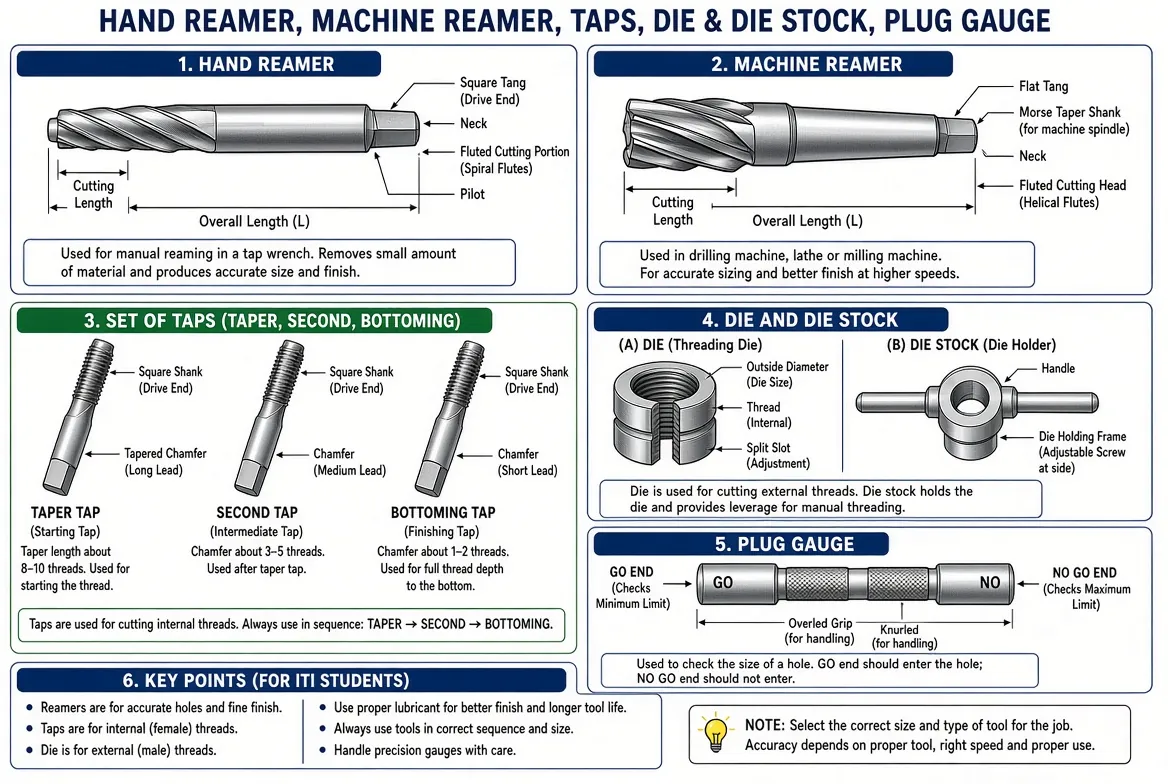
A drilled hole is not perfectly round, straight or smooth. Reaming finishes a drilled hole to an accurate size and good surface finish using a multi-tooth tool called a reamer.
Types of reamers
- Hand reamer – square end for a tap wrench; long taper lead at the start; turned by hand.
- Machine reamer – straight or taper shank; short bevel lead; used on drilling machine or lathe at low speed.
- Adjustable reamer – blades can be set to slightly different sizes.
- Taper reamer – for taper pin holes.
- Flutes may be straight or helical (helical gives smoother cutting).
Reaming allowance
The hole is first drilled slightly undersize. Leave only a small amount for the reamer to remove – about 0.2 mm for small holes up to 0.5 mm for larger holes. Too much allowance overloads the reamer; too little makes it rub.
Drill size for reaming = Reamer size − Reaming allowance
Example: 10 mm reamed hole → drill 9.8 mm
Example: 10 mm reamed hole → drill 9.8 mm
Correct method
- Keep the reamer square (in line) with the hole.
- Turn clockwise only – never turn a reamer backwards; it blunts the edges.
- Use cutting fluid (except on cast iron and brass).
- For machine reaming use about half the drilling speed.
Quick Revision
- Reaming gives accurate size and finish.
- Hand reamer – long taper lead; machine reamer – short bevel lead.
- Allowance about 0.2–0.5 mm.
- Never rotate a reamer anti-clockwise.
Your progress is saved on this device.