

Parts of a twist drill and its important angles: point angle 118°, lip clearance and helix angle.
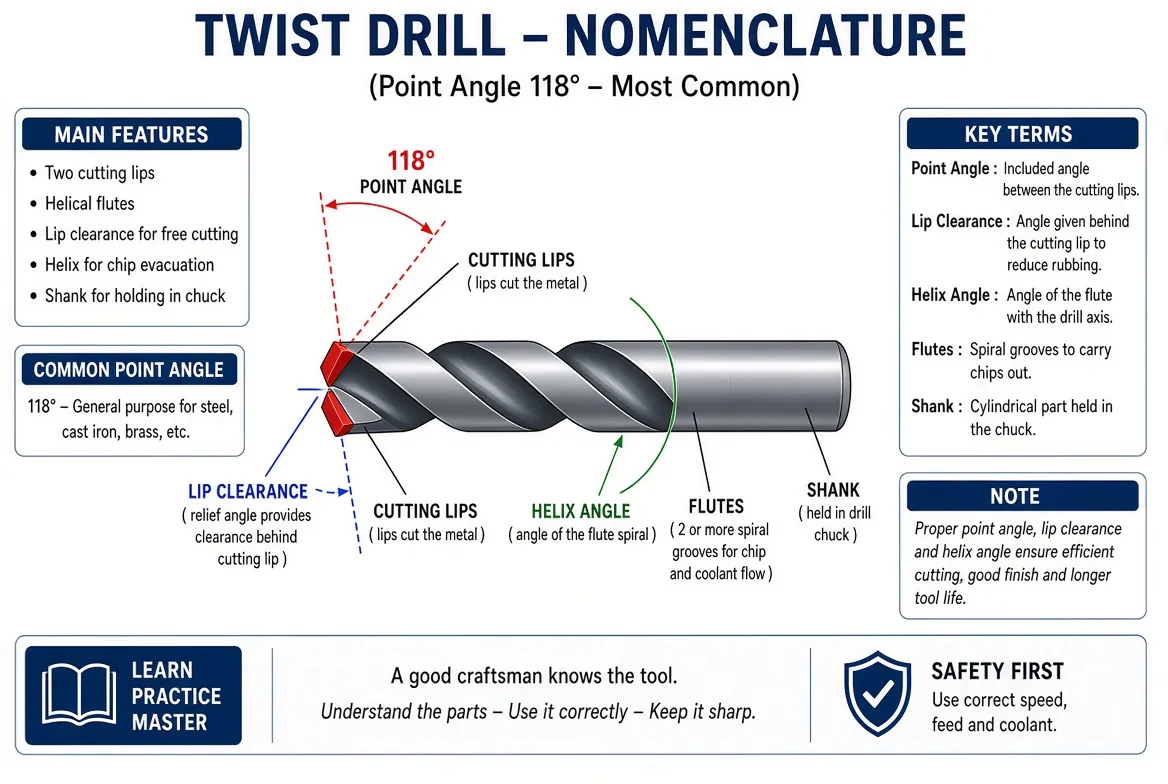
Drilling is making a round hole in a solid material with a rotating cutting tool called a drill. The most common drill is the twist drill, made of high-speed steel (HSS).
Parts of a twist drill
- Shank – part held in the machine. Straight shank (held in a drill chuck, usually up to 13 mm) or taper shank (Morse taper, fits directly in the spindle).
- Tang – flat end of a taper shank; helps to remove the drill with a drift.
- Body – from shank to point, has the flutes.
- Flutes – spiral grooves; carry chips out and coolant in.
- Land / margin – narrow strip along the flutes that gives the size and guides the drill.
- Web – central metal between flutes; gives strength.
- Point – cone-shaped cutting end with two lips (cutting edges) and the chisel edge.
Drill angles
| Angle | Value (general work) | Purpose |
|---|---|---|
| Point angle | 118° | Cutting angle of the two lips |
| Lip clearance angle | 8° – 12° | Lets the lips cut without rubbing |
| Helix angle (rake) | about 27° – 30° | Rake for cutting and chip flow |
| Chisel edge angle | 120° – 135° | Shows correct lip clearance |
Point angle by material Harder material → larger point angle (e.g. 135° for hard steel); soft material → smaller (e.g. 90° for plastics, 60° for wood). Both lips must have equal length and equal angle, otherwise the hole will be oversize.
Quick Revision
- Standard point angle 118°.
- Lip clearance 8°–12°; helix 27°–30°.
- Straight shank in chuck; taper shank in spindle/sleeve.
- Unequal lips → oversize hole.
Your progress is saved on this device.