

Parts and use of the bench vice; hacksaw frame, blade pitch and correct sawing method.
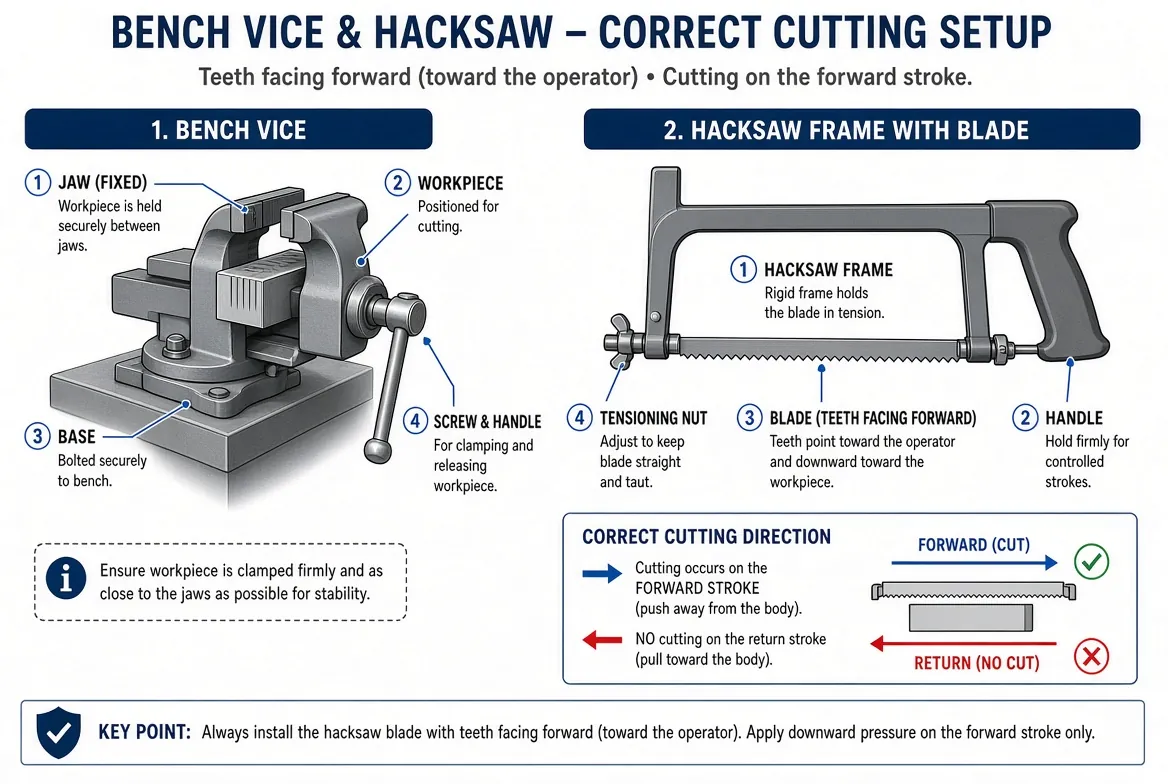
Bench vice
A holding device fixed on the work bench. It holds the job firmly for filing, sawing and chipping. Its size is given by the width of the jaws (e.g. 100 mm, 150 mm).
Parts: fixed jaw, movable jaw, hardened jaw plates, spindle (screw), handle, box nut, base.
- Height of the vice top should be at the worker's elbow height.
- Use soft jaws (vice clamps) of aluminium/copper to protect finished surfaces.
- Do not hammer on the handle to tighten; do not extend the handle with a pipe.
- Keep the screw clean and oiled.
Hacksaw
Used to cut metal by hand. It has a frame (fixed or adjustable), a blade, wing nut and handle.
Hacksaw blade
- Length: 250 mm or 300 mm (between hole centres).
- Material: high-speed steel or low-alloy steel. All-hard blades for rigid cutting, flexible blades (only teeth hardened) for general work.
- Pitch = distance between two teeth.
| Pitch | Use |
|---|---|
| 1.8 mm (coarse) | Soft metals, thick sections – aluminium, brass, mild steel bars |
| 1.4 mm | Mild steel, cast iron, general work |
| 1.0 mm | Angle iron, thicker tubes, tool steel |
| 0.8 mm (fine) | Thin tubes and sheets |
Rule At least three teeth must be in contact with the job. Fix the blade with teeth facing forward – it cuts on the forward stroke.
Sawing method
- Tension the blade properly with the wing nut.
- Start the cut with a small file nick and light pressure.
- Use the full length of the blade, about 40–50 strokes per minute.
- Pressure on forward stroke only; release on return stroke.
- Ease the pressure when the cut is about to finish.
Quick Revision
- Vice size = jaw width; top at elbow height.
- Teeth forward; cut on forward stroke.
- Fine pitch for thin work, coarse for soft/thick work.
- Minimum 3 teeth in contact.
Your progress is saved on this device.