

Principle, equipment and advantages of gas metal arc (CO₂/MIG) welding.
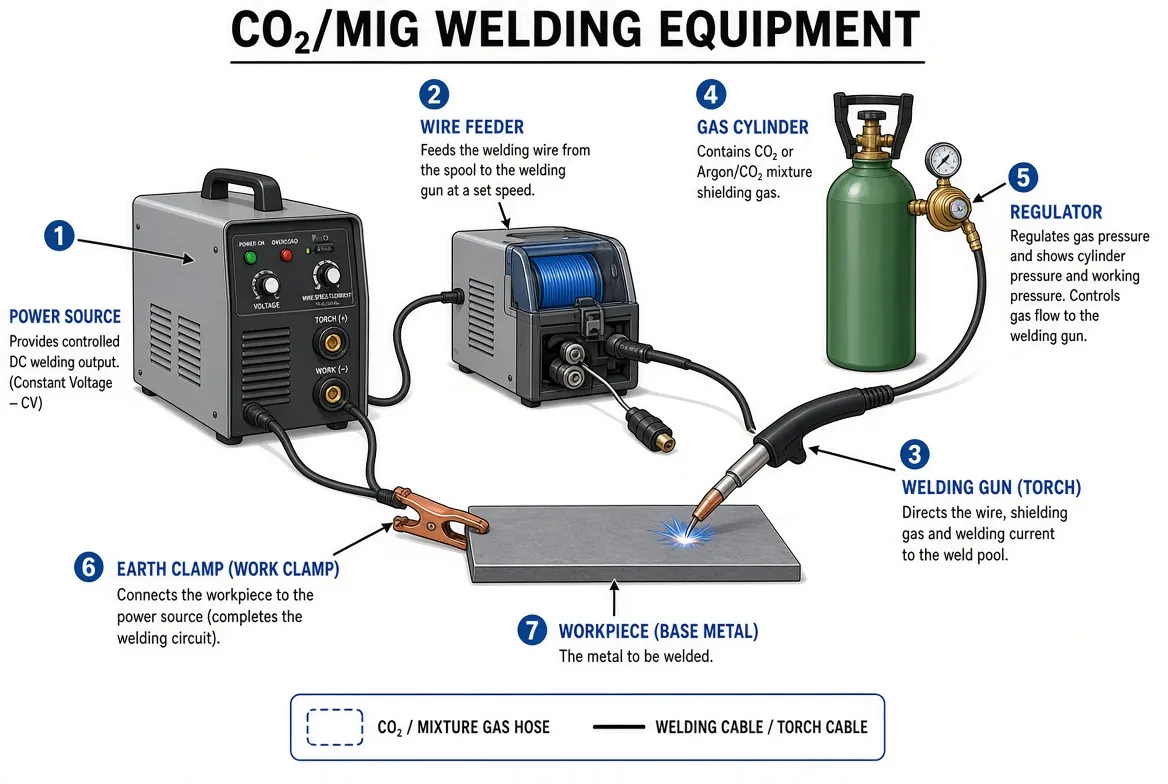
MIG welding (Metal Inert Gas), also called GMAW (Gas Metal Arc Welding), uses a continuous wire electrode fed through a gun. A shielding gas protects the molten weld pool from air. When carbon dioxide (CO₂) is used as the shielding gas it is called CO₂ welding (strictly, MAG – metal active gas).
Equipment
- Power source – constant voltage DC, used on DCEP.
- Wire feeder – feeds the wire from a spool at a set speed (sets the current).
- Welding gun (torch) – contact tip, nozzle, trigger switch.
- Shielding gas cylinder with regulator and flow meter (CO₂, argon or Ar + CO₂ mixture).
- Earth (work) cable and clamp.
Advantages
- High welding speed – no stopping to change electrodes.
- No slag to remove; clean welds.
- Easy to learn; can be automated.
- Good for thin and thick sheets of steel; aluminium with argon.
Limitations
- Gas shield is blown away by wind – difficult outdoors.
- Equipment is costlier than an arc welding set.
Typical settings Wire diameter 0.8–1.2 mm; gas flow about 12–18 litre/minute; stick-out (wire length out of contact tip) about 10–15 mm.
Quick Revision
- MIG = GMAW: continuous wire + shielding gas.
- CO₂ shielding → CO₂ welding.
- Polarity: DCEP; constant voltage power source.
- Main advantage: high speed, no slag.
Your progress is saved on this device.