

Cylinders, regulators, flashback arrestor, types of flame and the gas cutting process.
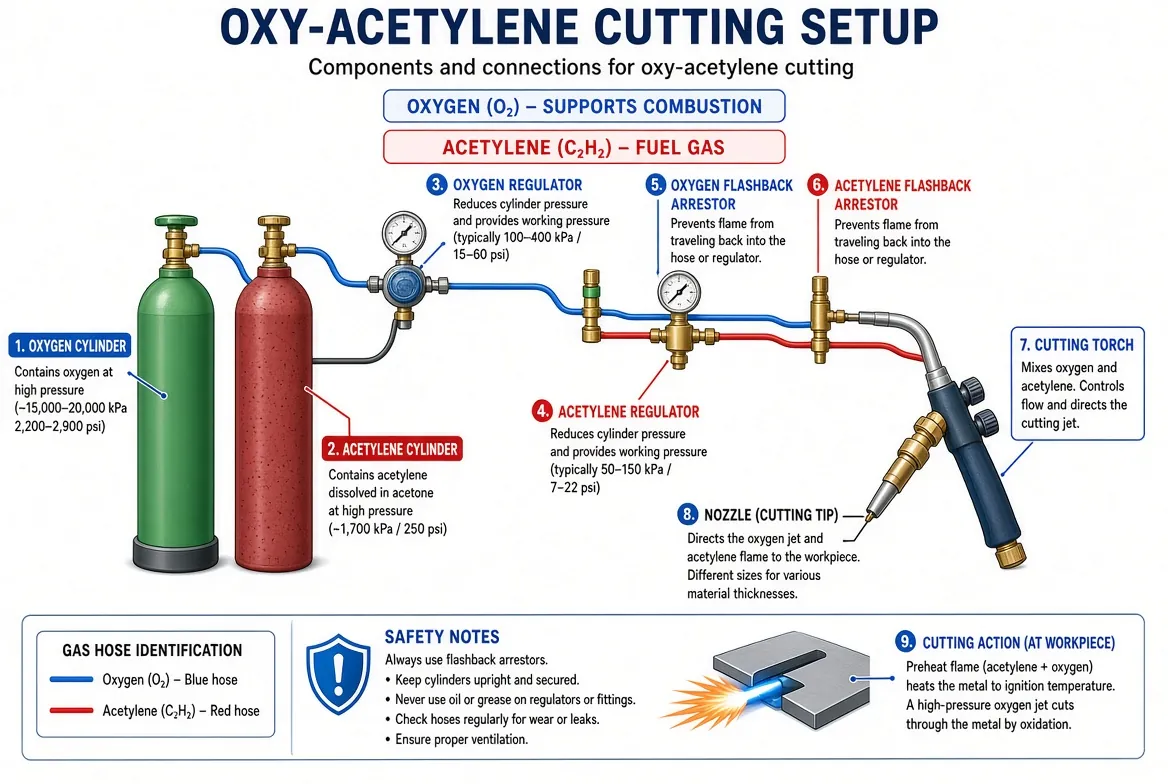
In oxy-acetylene cutting, steel is heated to its ignition temperature (bright red, about 870–900 °C) by a preheating flame and then a jet of pure cutting oxygen burns (oxidises) the metal and blows the oxide away, making a cut (kerf).
Equipment
| Part | Details |
|---|---|
| Oxygen cylinder | Painted black; right-hand threads; high pressure |
| Acetylene cylinder | Painted maroon; left-hand threads; acetylene dissolved in acetone in a porous mass |
| Regulators | Reduce cylinder pressure to working pressure; two gauges each |
| Hoses | Oxygen – black/blue, acetylene – red |
| Flashback arrestor | Stops a flame travelling back into the hose and cylinder |
| Cutting torch | Preheat valves + cutting oxygen lever; cutting nozzle |
Types of flame
- Neutral flame – oxygen : acetylene ≈ 1 : 1. Clear inner cone, about 3100–3200 °C. Used for most welding and for cutting preheat.
- Carburising (reducing) flame – excess acetylene; feather around the cone.
- Oxidising flame – excess oxygen; short, pointed cone, hissing sound; used for brass.
Cutting procedure
- Open cylinder valves slowly; set working pressures.
- Open acetylene and light with a spark lighter, then add oxygen to get a neutral flame.
- Preheat the starting edge to bright red.
- Press the cutting oxygen lever and move the torch steadily along the line.
- To stop: close cutting oxygen, then acetylene, then oxygen.
Never use acetylene at a pressure above 1 kg/cm² (about 15 psi) – it becomes unstable. Light the torch only with a spark lighter, never with a match or cigarette lighter.
Quick Revision
- Oxygen black (RH thread); acetylene maroon (LH thread).
- Neutral flame 1:1, ~3200 °C.
- Cutting = preheat + oxygen jet oxidises steel.
- Flashback arrestor prevents flame going back.
Your progress is saved on this device.