

Grooved, locked, lap seams; wired edge and hem – how sheet metal parts are joined and stiffened.
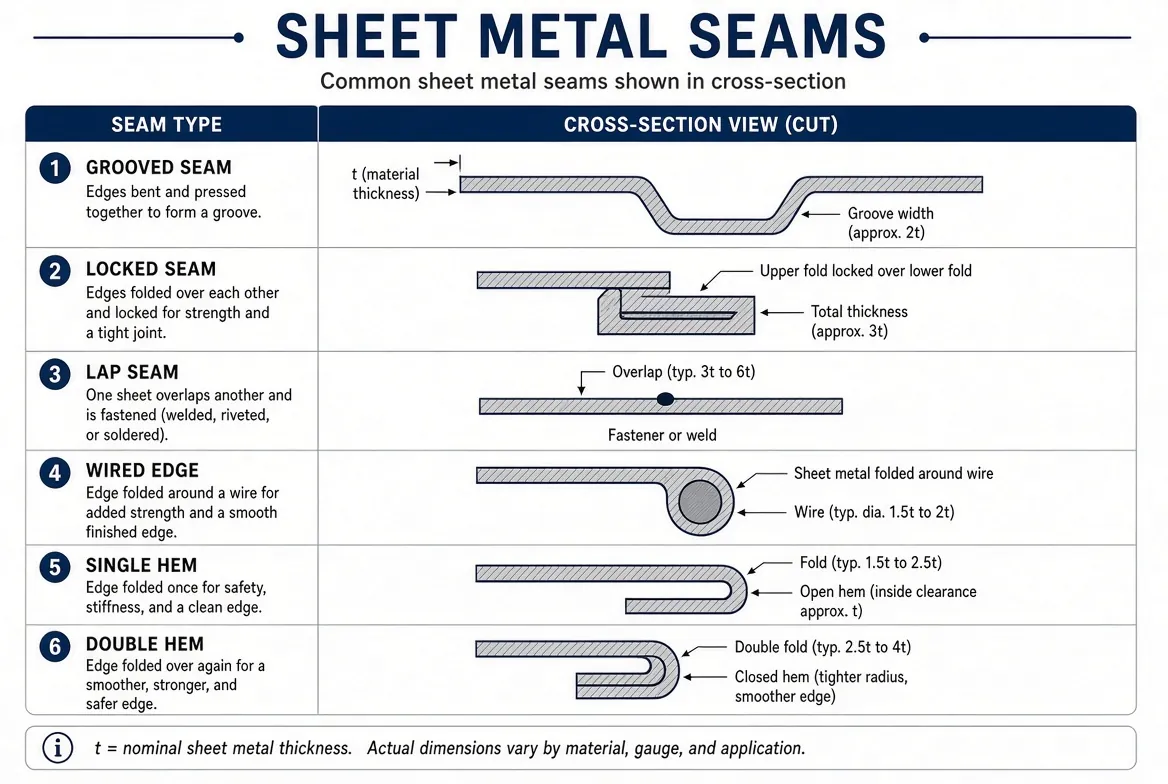
A seam is a joint made by folding and interlocking the edges of sheets. An edge is folded or wired to make the sheet stiff and to remove the sharp edge.
Seams
| Seam | How it is made / use |
|---|---|
| Lap seam | One sheet overlaps the other; joined by soldering or riveting. Simplest seam. |
| Grooved seam | Both edges folded, hooked together and pressed down with a hand groover. Strong and flat – used in pipes, buckets. |
| Locked (double) seam | Edges folded twice and locked – watertight; used in bottoms of containers and roofing. |
| Knocked-up seam | Used to fix bottoms of square or round containers. |
Edges
- Single hem – edge folded over once (180°).
- Double hem – folded twice; stronger.
- Wired edge – edge wrapped around a wire. Gives great strength and a smooth edge – used in buckets, trays, funnels.
Allowance for wired edge ≈ 2.5 × diameter of the wire
Allowance for grooved seam ≈ 3 × width of the seam
Allowance for grooved seam ≈ 3 × width of the seam
Why fold edges? Folding makes the job stiff, safe to handle and good-looking. The fold allowance must be added while marking the development.
Quick Revision
- Seams: lap, grooved, locked (double).
- Edges: single hem, double hem, wired edge.
- Wired edge allowance ≈ 2.5 × wire diameter.
Your progress is saved on this device.