

Safety in sheet metal work, snips, hand lever shears, mallets, hammers and stakes.
Safety in sheet metal work
- Sheet edges and burrs are as sharp as a knife – wear gloves while handling sheets.
- Wear goggles while cutting and drilling.
- Deburr (remove sharp edges) after every cut.
- Keep sheet scrap in a scrap bin, not on the floor.
Cutting tools
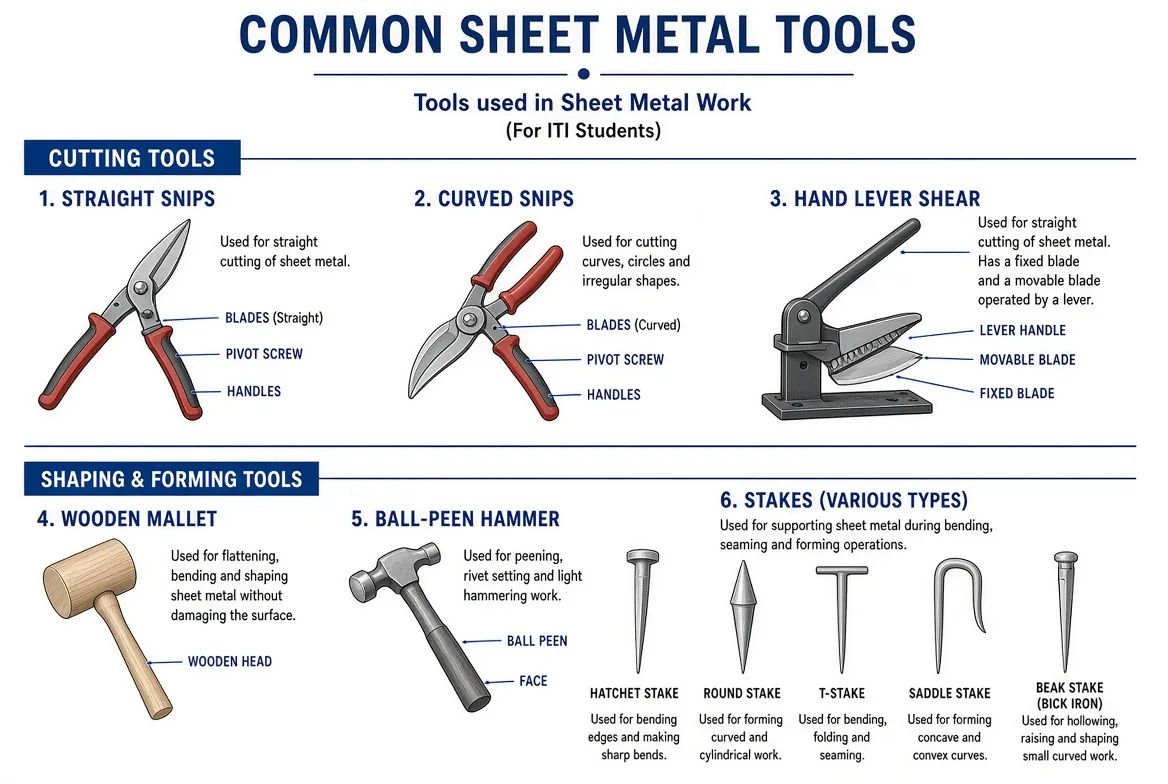
- Snips (tin snips) – hand cutting of thin sheets. Straight snips for straight lines and outside curves; bent snips for inside curves; universal and aviation snips for both.
- Hand lever shears (bench shears) – fixed on the bench, cut thicker sheets that snips cannot cut, using leverage.
Striking tools
- Mallets – wood, rubber, rawhide or plastic. Used to bend and shape sheet without marking or stretching it.
- Hammers – ball peen (riveting, general), straight and cross peen, setting hammer (closing seams), raising hammer (forming hollow shapes), planishing hammer (smoothing).
Stakes
Stakes are steel anvils of different shapes on which sheet is bent and formed. They fit in a stake holder (bench plate).
- Hatchet stake – sharp straight bends and edges.
- Half-moon stake – bending edges of curved work.
- Beak horn stake – forming cones and round shapes, riveting.
- Funnel stake – forming funnels and tapered jobs.
- Creasing stake – wiring and beading edges.
- Hand dolly – support while riveting and planishing.
Quick Revision
- Sheet edges are sharp – gloves and deburring.
- Snips for thin sheet; hand lever shears for thicker sheet.
- Mallet bends without marking the sheet.
- Stakes are anvils for forming.
Your progress is saved on this device.