

Types of rivet heads, riveting process, rivet length, pitch and edge distance.
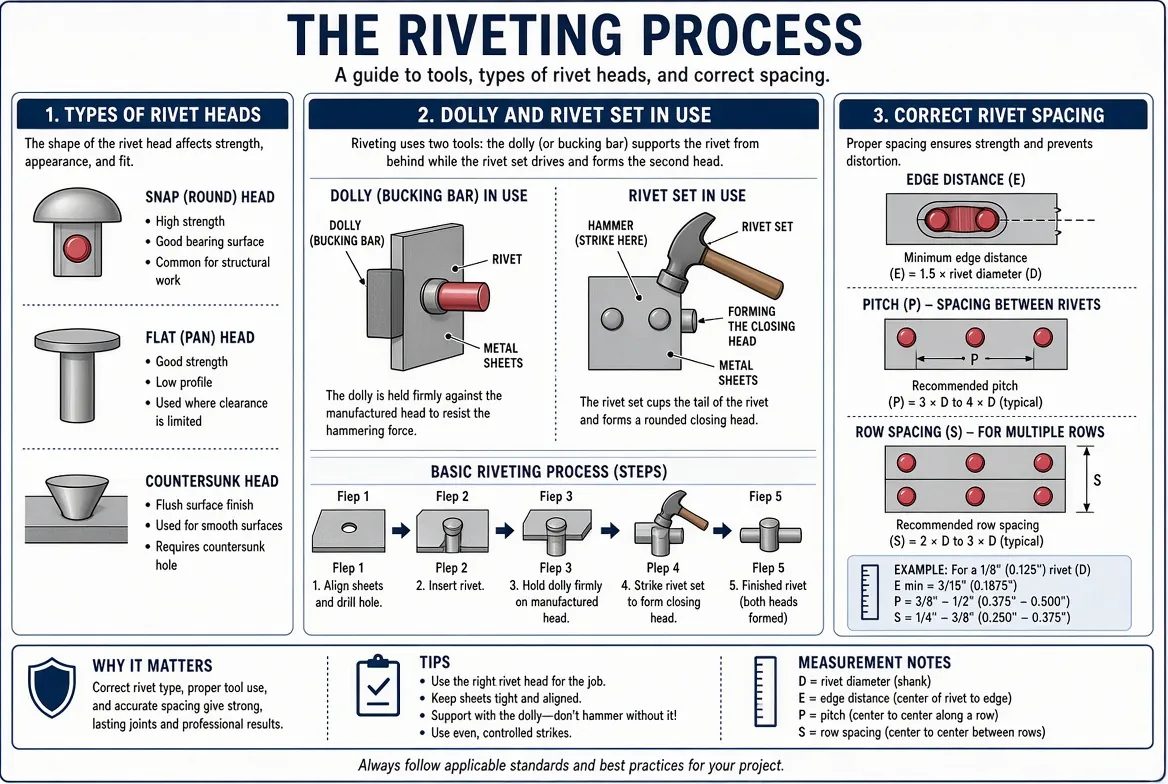
Riveting is a method of making a permanent joint between plates using rivets. A rivet has a head and a shank; the tail of the shank is formed into a second head after it is passed through the holes.
Rivet materials
Mild steel, copper, brass, aluminium. The rivet material should be the same as (or similar to) the plates, to avoid corrosion.
Types of rivet heads
- Snap (round) head – most common, general work.
- Pan head – heavy structural work.
- Countersunk head – where a flush (flat) surface is needed.
- Flat head – thin sheet metal work.
- Conical head – heavy work, hammered by hand.
- Pop (blind) rivets – when only one side of the job is reachable.
Proportions
Hole diameter ≈ rivet diameter + 0.1 mm (small clearance)
Length of rivet for snap head = total plate thickness + 1.5 d
Length for countersunk head = total plate thickness + 1 d
Pitch (centre to centre) ≈ 3 d · Edge distance (margin) ≈ 1.5 d
Length of rivet for snap head = total plate thickness + 1.5 d
Length for countersunk head = total plate thickness + 1 d
Pitch (centre to centre) ≈ 3 d · Edge distance (margin) ≈ 1.5 d
(d = diameter of rivet)
Riveting process (hand)
- Mark and drill the holes; deburr.
- Insert the rivet; support the head on a dolly (snap).
- Use a rivet set to close the plates together.
- Hammer the tail with a ball peen hammer to swell and shape it.
- Finish the head with a rivet snap.
Quick Revision
- Riveting = permanent joint.
- Snap head most common; countersunk for flush surface; pop rivet for one-side access.
- Rivet length = plate thickness + 1.5 d (snap head).
- Pitch ≈ 3 d, margin ≈ 1.5 d.
Your progress is saved on this device.