

Aim of TPM, its pillars and the six big losses – maintenance with the involvement of every worker.
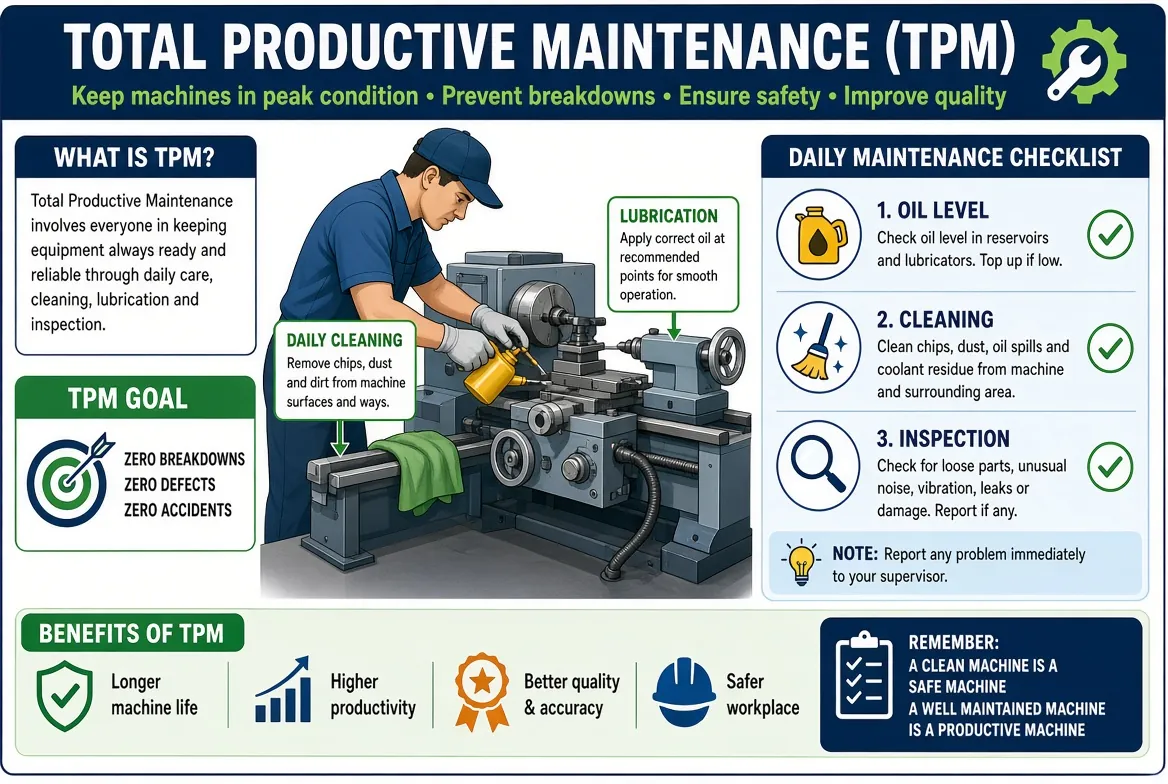
Total Productive Maintenance (TPM) is a system of maintaining machines with the involvement of all employees – from operators to top management – so that machines are always ready for production.
Aims of TPM
- Zero breakdowns, zero defects, zero accidents.
- Maximum Overall Equipment Effectiveness (OEE).
- Operators take care of their own machines (cleaning, lubrication, small checks).
Pillars of TPM
- Autonomous maintenance (Jishu Hozen) – daily care by the operator.
- Planned maintenance – scheduled maintenance by the maintenance team.
- Quality maintenance – keeping machines in condition to make zero defects.
- Focused improvement (Kaizen) – small continuous improvements.
- Early equipment management – learning from old machines when buying new ones.
- Training and education.
- Safety, health and environment.
- Office TPM – efficiency in support departments.
The foundation of TPM is 5S.
Six big losses
- Breakdowns · Set-up and adjustment · Small stops · Reduced speed · Defects in start-up · Production defects and rework.
Quick Revision
- TPM = maintenance with every worker's involvement.
- Aim: zero breakdown, zero defect, zero accident.
- Jishu Hozen = autonomous (operator) maintenance.
- Foundation of TPM: 5S.
Your progress is saved on this device.